Swimming Pool Crack Repair in Tucson, AZ
EXCELLENT Based on 3 reviews
 Posted on Google

 TysellA HUGE THANK YOU TO TUCSON POOL RESURFACING & PLASTERING!!!! The team delivered on our pool that was 36 years old. In as little as 3 months with labor and material shortages, start to finish, I cannot thank the crew enough for the spectacular work that was done. We have a 50K gallon pool and a 2K gallon spa. This was no easy task. Highly recommend!Posted on Google
 Lira Mathewson5 stars is not enough!! We wanted a full upgrade on our gunite pool and now it looks like a brand new luxury pool. The tile replacement around the waterline is gorgeous and the spa resurfacing came out perfect. The crew was so professional and friendly the whole time. HIGHLY recommend to everyone!!Posted on Google
 Jerry ShafferFrom the quote to the final result the whole experience was smooth and professional. The pool and spa resurfacing came out absolutely beautiful. 10 out of 10!
Transform Your Tucson Pool Today
WE SPECIALIZE IN COMPLETE POOL SOLUTIONS
- Licensed Pool Contractor Since 2021
- Desert Climate Specialists
- Quality Materials & Workmanship
- Free Estimates & Consultations
- Full-Service Pool Care
SEND US A MESSAGE
Why Pools Crack: The Tucson Factors
- Extreme Temperature Swings: Tucson’s climate puts pool surfaces through constant thermal cycling. Summer days well above 100 degrees, sharp drops after sunset, and cool winter nights make plaster, tile, coping, and concrete expand and contract over and over. That movement strains the pool surface and the joints between materials, especially along the waterline, where tile, plaster, and coping meet and each moves at a slightly different rate. Over years, this repeated stress is one of the most common sources of cracks in Tucson pools.
- Soil Conditions and Ground Movement: Soils across the Tucson basin vary widely, from layers of caliche to areas with clay that swells when wet and shrinks as it dries. Pools built on poorly compacted fill, on expansive soils, or on sloped hillside lots are more likely to see ground movement that strains the shell. When the soil under or around a pool shifts, the shell can crack under the uneven support.
- Monsoon Saturation Followed by Drying: Tucson’s monsoon season soaks the ground with heavy, sudden rain, and long dry stretches follow. That wet-dry cycle can make soil swell and settle around the pool, especially where drainage sends runoff toward the pool deck instead of away from it. Poor drainage around a pool is a frequent contributor to deck cracks, coping separation, and in more serious cases, shell movement.
- Drained Pools in the Desert Sun: A pool left empty in Tucson’s heat is at real risk. Plaster dries out and shrinks quickly when exposed to direct sun and low humidity, which can cause widespread surface cracking. In some conditions, groundwater pressure under an empty shell can also cause structural damage. This is why we manage drain times carefully during every project and never leave a pool empty longer than the work requires.
- Age and Water Chemistry: As pool plaster ages, it naturally develops fine surface cracks. Water chemistry that stays out of balance for long periods speeds up that aging. Aggressive water can etch and weaken the plaster surface, while Tucson’s hard water can leave calcium deposits in existing cracks. Older pools reaching the end of their plaster’s service life often show crazing and surface cracks that signal it is time for resurfacing.
- Original Construction Quality: Some cracks trace back to how the pool was built. Inadequate steel reinforcement, inconsistent shell thickness, poor soil compaction before construction, or improper curing of the concrete can all leave weak points that crack years later. Knowing whether a crack comes from a construction issue or an environmental one helps determine the right repair.
Types of Pool Cracks and What They Mean
- Craze Cracks and Check Cracks: Craze cracks are fine, shallow lines that form a spiderweb or map-like pattern across the plaster surface. Check cracks are similar shallow cracks that may appear on their own or in small clusters. These cracks sit in the plaster layer only, do not go through the shell, and usually do not cause leaks. They are common in aging plaster and in plaster that cured too quickly. They are mostly a cosmetic concern, though they can collect dirt and stains and make the surface feel rough. Widespread crazing is often a sign that the pool is ready for resurfacing.
- Shrinkage Cracks: Shrinkage cracks form when plaster or concrete loses moisture too quickly during curing, or when a drained pool sits exposed to the sun. They are often wider and more defined than craze cracks but still limited to the surface layer. They are typically repaired as part of surface patching or resurfacing.
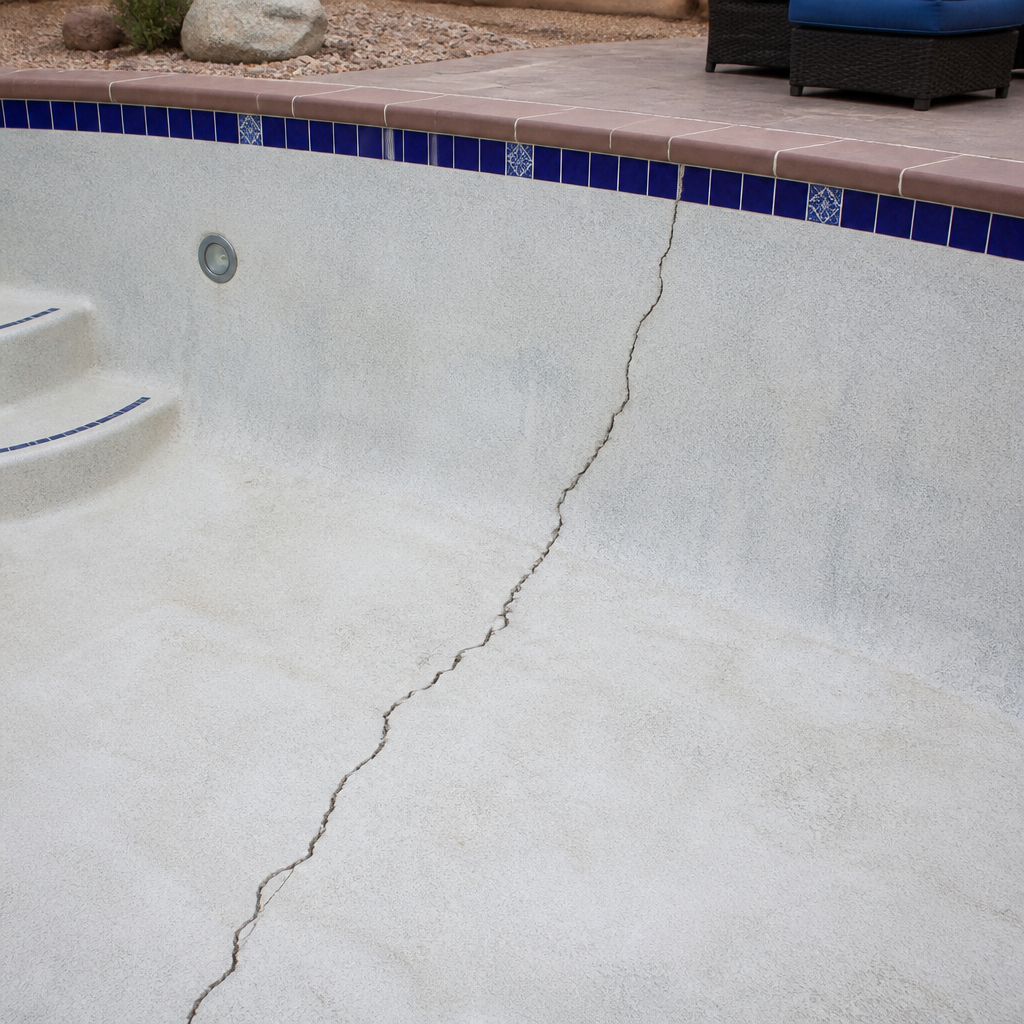
- Structural Cracks: Structural cracks go through the plaster and into the concrete or gunite shell itself. They are usually longer, wider, and more defined than surface cracks, and they often run in a straight or jagged line across the pool floor or up a wall. Structural cracks can let water escape from the pool and need a proper structural repair rather than a surface patch. Signs of a structural crack include a crack that keeps growing, a crack with one side higher than the other, unexplained water loss, or a crack that comes back after a surface repair.
- Bond Beam and Coping Cracks: The bond beam is the thick, reinforced top edge of the pool shell that supports the coping and tile. Cracks in the bond beam, often visible as cracks in the tile line or loose and cracked coping stones, are common in Tucson because this area takes the brunt of thermal movement and deck movement. Left unrepaired, bond beam cracks let water behind the tile and coping, which leads to loose tile, failed grout, and further deterioration.
- Deck-to-Coping Separation: Where the pool deck meets the coping, there should be a flexible expansion joint that lets the deck and the pool move independently. When that joint fails, cracks, or was never installed properly, the deck can push against the coping, cracking stones and tile, and water can run down into the gap. Failed expansion joints are one of the most common and most preventable sources of pool cracking we see in Tucson.
- Cracks Around Fittings and Penetrations: Cracks often form around skimmers, return fittings, main drains, light niches, and steps, where the shell is interrupted by a fitting or a change in shape. Cracks around a skimmer are especially common, because the skimmer throat sits right at the bond beam where movement is greatest. These cracks are a frequent source of leaks and need careful repair to restore a watertight seal.
Warning Signs Your Pool Needs Crack Repair
- Unexplained water loss beyond normal evaporation, especially if the pool keeps losing water when the equipment is off. Tucson pools lose a lot of water to evaporation in summer, which can hide a leak. A bucket test helps separate evaporation from leaking.
- Visible cracks in the plaster that are wider than a hairline, that have grown since you first noticed them, or that run in a long continuous line across the floor or walls.
- Cracked or loose tile along the waterline, missing grout, or tile that sounds hollow when tapped.
- Cracked, loose, or shifting coping stones around the pool edge.
- Gaps between the deck and coping or a deck that has lifted, sunk, or tilted near the pool.
- Wet or soft soil, sinking pavers, or erosion near the pool or equipment that does not match recent rain or irrigation.
- Rust stains coming through the plaster, which can mean water has reached the steel reinforcement inside the shell.
- Cracks that return after a previous patch, which usually means the underlying cause was never addressed.
Pool Crack Repair Services We Offer in Tucson
Crack Inspection and Leak Detection
Surface Crack Repair
Structural Crack Repair
Bond Beam, Tile Line, and Coping Repair
Expansion Joint Repair and Replacement
Fitting, Skimmer, and Light Niche Crack Repair
Crack Repair Combined With Resurfacing
Ready to Start Your Tucson Pool Project?
Why Fast Crack Repair Matters
- Water Loss and Water Bills A leaking crack can lose a surprising amount of water every day, on top of the heavy evaporation Tucson pools already deal with. Beyond the cost of the water, constant refilling with hard Tucson water drives up calcium levels and makes water chemistry harder to manage.
- Soil Erosion Beneath the Pool Water escaping through a crack does not just disappear. It saturates and can wash away the soil supporting the pool shell and deck. Over time, this can create voids under the pool that lead to further settling, more cracking, and deck damage that is far more expensive to correct than the original crack.
- Corrosion of the Steel Reinforcement Pool shells are reinforced with steel. When water reaches that steel through a crack, it begins to rust. Rusting steel expands, which can widen the crack, cause concrete to break away, and weaken the shell. Rust stains bleeding through the plaster are a warning sign that this process has already started.
- Cracks Grow Thermal cycling, ground movement, and water infiltration all work on an open crack continually. Cracks that are repaired early are smaller, simpler, and less expensive to fix than cracks that have been left to grow through several Tucson summers.
Preventing Future Cracks in Your Tucson Pool
- Maintain the expansion joint between the deck and coping, and have it resealed when the sealant becomes hard, cracked, or separated.
- Manage drainage around the pool so roof runoff, irrigation, and monsoon rain flow away from the pool deck rather than toward it.
- Keep water chemistry balanced to protect the plaster surface from etching and premature aging.
- Keep the pool full. Avoid draining your pool unless it is necessary, and only drain it under professional guidance, particularly during Tucson’s hottest months.
- Address small cracks early before water infiltration and thermal movement turn them into larger problems.
- Watch for changes in water loss, tile, coping, and deck condition, and schedule an inspection if something changes.
Pool Crack Repair Across Tucson Neighborhoods
- Catalina Foothills, where hillside lots, sloped terrain, and custom pool construction create unique structural demands that call for careful crack diagnosis and repair
- Oro Valley, where established pools with aging plaster and bond beams are strong candidates for crack repair combined with resurfacing
- Marana, a rapidly growing northwest Tucson community where both newer pools showing early settling cracks and older pools with surface wear need professional repair
- Casas Adobes, a mature northwest Tucson neighborhood where many older pools show crazing, tile line cracks, and coping separation from decades of thermal cycling
- Rita Ranch, where southeast Tucson families rely on prompt crack repair to keep active pools watertight through a long swim season
- Sahuarita and Green Valley, where seasonal residents benefit from inspections that catch cracks and leaks before they grow while the home is unoccupied
- Vail and Corona de Tucson, growing east-side communities where pools on newer lots can show cracks related to soil settling in the years after construction
- Central and Midtown Tucson, including established neighborhoods where older pools often need bond beam, coping, and structural crack repairs as part of a broader renovation
- South Tucson and surrounding communities, where residential pool owners benefit from honest crack diagnosis and durable repairs that protect their pool investment
Our Pool Crack Repair Process
Step 1: Inspection and Diagnosis We start with a thorough inspection of your pool surface, tile line, coping, deck, and fittings. We identify every crack, assess its type and depth, check for active leaks with dye testing where needed, and evaluate the likely cause, including drainage, soil, expansion joint condition, and plaster age.
Step 2: Repair Plan and Written Proposal We explain what we found in plain language, including which cracks are cosmetic, which are structural, and what is causing them. You receive a written proposal covering the recommended repairs, the options available, such as patching versus resurfacing, and the project timeline. We answer every question before any work begins.
Step 3: Draining and Preparation When the repair requires it, the pool is drained under controlled conditions with careful attention to Tucson’s heat and the risks of leaving a shell exposed. The repair areas are cleaned, and plaster, tile, or coping is removed as needed to fully expose each crack.
Step 4: Crack Repair Each crack is repaired using the method suited to its type and cause. Surface cracks are opened and filled. Structural cracks are channeled, reinforced, filled with structural repair material, and waterproofed. Bond beam damage is repaired before tile and coping are reset. Failed expansion joints are removed and replaced.
Step 5: Surface Restoration Repaired areas are finished with patch plaster, new tile, reset coping, or a full resurfacing, depending on the scope of the project. Our goal is a finished surface that is watertight, durable, and as visually consistent as possible.
Step 6: Refill, Startup, and Verification The pool is refilled carefully, and the new surface is brought up with a proper startup process to protect the fresh finish. We monitor repaired areas to confirm the repairs are holding and water loss has been resolved.
Step 7: Walkthrough and Prevention Guidance We walk through the completed repair with you, explain what was done and why, and share practical steps such as drainage improvements, expansion joint care, and water chemistry tips that help prevent new cracks from forming.
Stop Small Cracks Before They Become Big Problems