Tucson Pool Resurfacing & Plastering

Pool Coping in Tucson, AZ
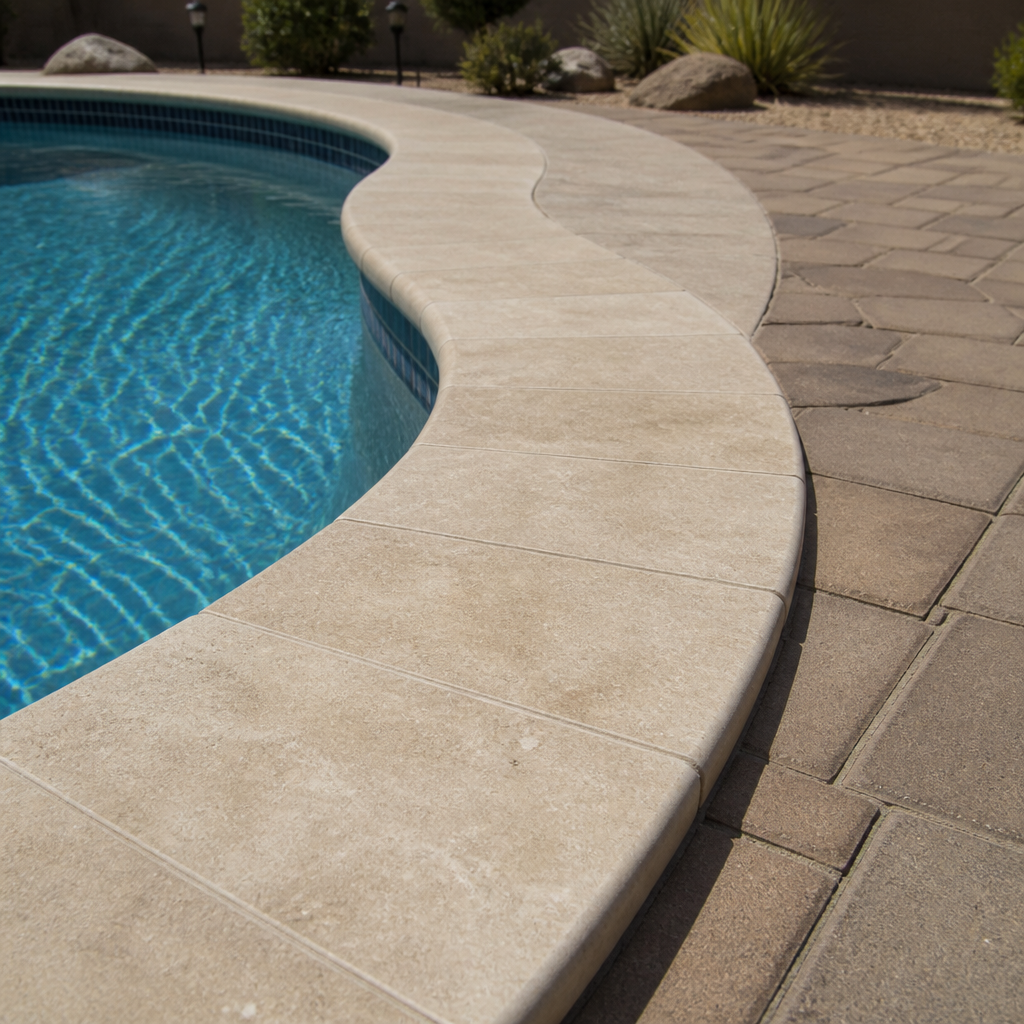
There is a detail around the edge of every swimming pool that most people notice without consciously registering what they are looking at. That detail is pool coping, and it does more for the overall appearance, safety, and structural integrity of a pool than most homeowners realize until it starts to fail. Pool coping in Tucson, AZ is the cap material that runs along the perimeter of the pool shell, sitting at the very top edge where the pool structure meets the surrounding deck. It defines the visual border of the pool, provides a safe and comfortable edge for swimmers, protects the pool shell’s bond beam from water infiltration and the deterioration that follows, and establishes the visual transition between the pool interior and the deck that frames it. At Tucson Pool Resurfacing & Plastering, we provide professional pool coping installation, replacement, and repair services for homeowners throughout the greater Tucson area, from Oro Valley and Marana to Catalina Foothills, Casas Adobes, Rita Ranch, and all surrounding communities. Whether you are building a new pool and selecting coping for the first time, replacing deteriorated or outdated coping as part of a pool renovation, or repairing specific sections that have cracked, shifted, or pulled away from the pool edge, our team brings the craftsmanship, material knowledge, and local climate expertise to deliver coping work that looks exceptional and performs reliably in Southern Arizona’s demanding environment.
Posted on Google Google
Tysell profile picture
Tysell
Google star 1Google star 2Google star 3Google star 4Google star 5Trustindex verifies that the original source of the review is Google.
A HUGE THANK YOU TO TUCSON POOL RESURFACING & PLASTERING!!!! The team delivered on our pool that was 36 years old. In as little as 3 months with labor and material shortages, start to finish, I cannot thank the crew enough for the spectacular work that was done. We have a 50K gallon pool and a 2K gallon spa. This was no easy task. Highly recommend!
Posted on Google Google
Lira Mathewson profile picture
Lira Mathewson
Google star 1Google star 2Google star 3Google star 4Google star 5Trustindex verifies that the original source of the review is Google.
5 stars is not enough!! We wanted a full upgrade on our gunite pool and now it looks like a brand new luxury pool. The tile replacement around the waterline is gorgeous and the spa resurfacing came out perfect. The crew was so professional and friendly the whole time. HIGHLY recommend to everyone!!
Posted on Google Google
Jerry Shaffer profile picture
Jerry Shaffer
Google star 1Google star 2Google star 3Google star 4Google star 5Trustindex verifies that the original source of the review is Google.
From the quote to the final result the whole experience was smooth and professional. The pool and spa resurfacing came out absolutely beautiful. 10 out of 10!

Transform Your Tucson Pool Today

POOL RESTORATION EXPERTISE

WE SPECIALIZE IN COMPLETE POOL SOLUTIONS

Expert pool resurfacing, plastering, remodeling, equipment services, and complete pool restoration—backed by quality craftsmanship and years of experience serving Tucson and Southern Arizona.

SEND US A MESSAGE

YES! WE REPLY TO THESE MESSAGES ASAP!

What Is Pool Coping and Why Does It Matter?

Pool coping is the cap installed along the top edge of the pool shell, forming the finished perimeter border between the pool interior and the surrounding deck or landscape. It serves multiple functions simultaneously, and understanding those functions helps explain why coping quality and condition matter so much to the long-term performance of the entire pool.
  • Structural Protection The bond beam is the uppermost structural element of the pool shell, running along the top of the gunite or concrete shell where the pool walls terminate. The bond beam is vulnerable to water infiltration, chemical exposure, and physical damage if left exposed or inadequately capped. Properly installed coping covers and protects the bond beam, directing water away from the shell structure and preventing the freeze-thaw and wet-dry cycling that degrades exposed concrete over time.
  • In Tucson’s environment, the bond beam faces specific challenges from hard water mineral deposits, intense UV exposure, and the thermal cycling associated with our dramatic day-night temperature swings. Quality coping material and proper installation protects the bond beam from these exposures and extends the structural life of the pool shell significantly.
  • Safety at the Pool Edge The pool coping provides the surface that swimmers grip when resting at the pool edge, push off from when entering the water, and walk along when moving around the pool perimeter. A coping material and profile that is comfortable to grip, appropriately textured for wet conditions, and free of sharp edges or deteriorating sections contributes directly to pool safety. Coping that has cracked, shifted, or developed loose sections creates genuine hazards at the pool edge that affect both comfort and safety.
  • Aesthetic Definition Visually, coping defines the pool’s character as much as any single element. The coping profile, material, color, and finish establish the visual border that frames the pool interior and transitions to the surrounding deck. A pool with quality coping that complements the interior surface and deck finish looks complete and intentional. A pool with cracked, discolored, or poorly matched coping looks neglected regardless of how nice the water looks or how well the interior surface is maintained. In Tucson neighborhoods where outdoor living spaces are carefully designed and maintained, such as the Catalina Foothills, Casas Adobes, and Oro Valley, pool coping is a visible design element that contributes meaningfully to the overall impression of the property’s outdoor living area.
  • Deck Separation and Expansion Joint Pool coping also serves as the transition element between the pool shell and the surrounding deck, incorporating the expansion joint that allows the pool structure and deck to move independently of each other. This separation is critical in Tucson’s thermally active environment, where the pool shell and deck concrete undergo significant expansion and contraction cycles with temperature changes. A properly executed coping installation accommodates this movement without cracking or lifting, while a rigid connection between pool and deck that ignores movement needs will crack under the thermal stress Tucson’s climate creates.

Why Tucson's Climate Makes Pool Coping More Demanding

Pool coping anywhere experiences wear and stress over time. In Tucson, several specific environmental factors accelerate coping deterioration and make the quality of both material selection and installation more consequential than in more temperate climates.
  • Extreme Thermal Cycling Tucson’s summer days exceed 100 degrees Fahrenheit regularly, and the desert’s low humidity means temperatures can drop 30 to 40 degrees between afternoon peak and predawn lows even in summer. This dramatic daily thermal cycling creates expansion and contraction cycles in coping materials and the adhesive systems bonding them to the pool shell that accumulate stress over time. Materials that cannot accommodate this movement, or installations that do not incorporate appropriate flexible bonding systems and expansion joints, develop cracking and adhesion failures at an accelerated rate in Tucson’s environment.
  • Hard Water and Calcium Deposits Tucson’s hard water deposits calcium on coping surfaces continuously, particularly on the underside of coping overhangs and at the joint between the coping and the waterline tile. This calcium accumulation, if not managed through regular cleaning and proper water chemistry, builds into heavy scale deposits that are difficult to remove and visually detracting. On porous coping materials, calcium infiltration into the surface can cause spalling and surface deterioration over time. Selecting coping materials with appropriate density and porosity for Tucson’s hard water conditions, and maintaining proper pool water chemistry, significantly reduces calcium-related coping deterioration.
  • Intense UV Radiation Coping sits at the pool’s perimeter and receives direct, continuous UV exposure at some of the highest radiation levels in the continental United States. UV exposure fades color in pigmented coping materials, breaks down sealers that protect porous coping surfaces, and degrades the adhesive systems bonding coping to the pool shell over time. Using UV-stable coping materials and maintaining appropriate sealer protection on porous coping surfaces reduces UV-related deterioration in Tucson’s intense sun.
  • Monsoon Season Soil Movement Tucson’s monsoon season brings significant rainfall to desert soils that have been extremely dry for months. The resulting soil expansion creates pressure events beneath and around pool structures that contribute to coping shifting, cracking, and pulling away from the pool edge. The transition back to dry conditions causes the reverse movement as soils shrink. This seasonal soil movement cycle is one of the most common underlying causes of coping failure in Tucson pools and one that requires awareness in both installation technique and repair approach.
  • Freeze-Thaw Effects While Tucson rarely experiences the hard freezes common in northern climates, subfreezing temperatures do occur on winter nights, particularly in higher-elevation neighborhoods. Water that has infiltrated into porous coping materials or behind improperly sealed coping joints can freeze and expand, creating internal pressure that causes surface spalling and joint failure. Using appropriate coping materials and maintaining sealed joints reduces freeze-thaw vulnerability in Tucson’s occasional freeze events.

Pool Coping Services We Offer in Tucson

Our pool coping work covers the full range of services that residential pool owners in Tucson need, from new installation on fresh pool builds to renovation, replacement, and targeted repair of specific failing sections.

New Pool Coping Installation

New coping installation on a freshly built pool is the opportunity to select and install the right coping material from the start, with proper substrate preparation, correct adhesive and bonding systems, and appropriate expansion joint placement that sets the installation up for maximum longevity in Tucson’s demanding conditions. We work with you through the material selection process to choose coping that complements your pool’s interior finish, your deck material, and your overall design aesthetic. Material performance in Tucson’s specific climate is a key consideration alongside aesthetics, and we help you understand how different coping options perform in our hard water, high UV, thermally active environment before making a selection.
Installation begins with thorough bond beam preparation to ensure the substrate is clean, sound, and properly profiled for the adhesive system being used. Coping units are dry-laid to establish the correct pattern and overhang before any adhesive is applied, ensuring alignment is correct and any cuts needed at corners or transitions are identified and made accurately. Adhesive is applied using professional-grade setting materials rated for pool coping applications, and coping units are set with consistent joint spacing and proper overhang over the waterline tile. Expansion joints are incorporated at appropriate intervals and locations to accommodate the thermal movement that Tucson’s temperature cycling drives in the coping installation. Joints are filled with appropriate flexible sealant rather than rigid grout, allowing the movement the installation needs to accommodate without cracking.
After the coping adhesive has cured, joints between coping units are filled with appropriate mortar or sealant depending on the coping material and joint type, and the installation is cleaned and inspected before the deck is poured against the coping or before the pool is returned to service.

Pool Coping Replacement and Renovation

Coping replacement as part of a pool renovation is one of the most transformative changes you can make to a pool’s exterior appearance. Outdated coping that no longer reflects the design aesthetic you want, coping that is too deteriorated to repair effectively, or coping that was simply a poor choice for Tucson’s conditions and has failed prematurely are all strong candidates for complete replacement. Full coping replacement involves removing all existing coping and adhesive residue from the bond beam, preparing the bond beam surface correctly for the new installation, and installing new coping with proper adhesive systems, correct expansion joint placement, and the attention to detail that produces a long-lasting result.
Coping replacement delivers its best results when coordinated with other pool renovation work. When a pool is drained for interior resurfacing, the coping area is accessible and the timing is ideal for addressing coping that needs replacement. Selecting new interior finish, new tile, and new coping together allows all three elements to be chosen as a coordinated design rather than independently, producing a cohesive renovation result.

Pool Coping Repair

Not every coping situation requires full replacement. When coping damage is localized to specific sections and the majority of the installation remains sound, targeted repair is a practical and cost-effective approach to restoring function and appearance.
Coping repairs we handle include:
  • Cracked coping repair addresses individual coping units that have developed cracks due to thermal stress, impact, or substrate movement. Cracks that are stable and do not affect structural integrity can be filled and sealed to restore appearance and prevent water infiltration. Coping units that have cracked through completely and compromised their structural integrity or surface quality are replaced individually.
  • Resetting shifted or lifted coping addresses coping units that have moved out of their original position due to adhesive failure, soil movement, or inadequate original installation. Shifted coping creates visual discontinuity at the pool edge and gaps that allow water infiltration behind the coping into the bond beam. Resetting involves carefully removing the affected units without damaging adjacent coping, cleaning old adhesive from both the unit and the substrate, and reinstalling with fresh adhesive and correct alignment.
  • Joint repair and resealing addresses deteriorated mortar or sealant in the joints between coping units and at the expansion joint between the coping and the deck. Failed joints allow water infiltration and contribute to further deterioration of the installation. Repointing mortar joints and replacing failed expansion joint sealant restores the installation’s waterproofing and accommodates movement correctly.
  • Spalling and surface repair addresses coping surfaces that have lost their top layer due to freeze-thaw action, chemical attack, or UV degradation. Surface repair products compatible with the coping material restore a clean surface profile and re-establish protective sealing over the repaired area.

Pool Coping Materials and Options for Tucson Pools

Coping material selection is one of the most important design decisions in a pool project because it so significantly influences both the visual character of the finished pool and the long-term maintenance demands of the installation. Here is a detailed look at the coping options we work with and how they perform in Tucson’s specific environment.

Natural Travertine Coping

Travertine is one of the most popular coping materials for Tucson pools, and with good reason. Its natural warm tones, from creamy ivory to rich walnut and gold, complement the desert landscape beautifully and pair well with both pebble and quartz pool interior finishes. Travertine has a naturally textured surface that provides good grip when wet, and its open pore structure keeps it cooler underfoot than dense stone or concrete alternatives, which is a genuine practical benefit in Tucson’s summer heat.
Travertine coping is available in both tumbled and honed profiles. Tumbled travertine has a naturally worn, slightly irregular surface with softened edges that gives the pool a relaxed, organic aesthetic. Honed travertine has a more refined, flat surface with clean edges that suits more formal or contemporary pool designs. Both finishes are popular in Tucson depending on the design direction of the project.
The primary maintenance consideration for travertine in Tucson’s pool environment is its porosity. Travertine’s open pore structure, which contributes to its cooler surface temperature, also means it absorbs pool water chemicals and calcium more readily than denser materials. Regular sealing with an appropriate penetrating sealer reduces this absorption and protects the stone from chemical staining and calcium infiltration. Properly sealed and maintained travertine performs very well in Tucson’s conditions and develops a beautiful natural patina over time.

Natural Stone Coping

Beyond travertine, a range of natural stone options is available for pool coping applications, including bluestone, limestone, sandstone, granite, and slate. Each has distinct visual characteristics, performance properties, and maintenance requirements that suit different design goals and pool environments.
  • Bluestone has a dense, consistent blue-gray character that suits contemporary and formal pool designs with a refined, architectural aesthetic. Its density makes it more resistant to staining and chemical absorption than more porous stones, and it holds up well in Tucson’s thermal cycling environment.
  • Limestone in its denser varieties shares some of travertine’s warm tone characteristics with a more uniform, refined surface. Softer limestone varieties require more care in Tucson’s chemically active pool environment.
  • Granite is among the most durable natural stone options for coping applications, with excellent resistance to staining, chemical exposure, and physical wear. Its density and hardness make it well-suited to Tucson’s demanding conditions, and it is available in a wide range of colors and finishes.
Natural stone coping is cut and profiled to the appropriate coping shape, with the pool-facing edge finished in a bullnose or other appropriate profile that provides a comfortable edge for swimmers. Stone selection, sourcing, and cutting quality all affect the finished appearance and performance of natural stone coping installations.

Precast Concrete Coping

Precast concrete coping offers a reliable, consistent, and accessible coping option that is widely used in Tucson residential pools. Manufactured in a range of standard profiles, sizes, and colors, precast concrete coping provides a clean, uniform appearance at the pool edge with good durability and manageable maintenance requirements.
Precast concrete coping is available in bullnose profiles for classic pool edge aesthetics, square-edge profiles for more contemporary designs, and specialty profiles that suit specific pool styles and preferences. Color options range from standard gray and tan tones to a range of pigmented options that can complement pool interior finishes and deck colors.
The performance of precast concrete coping in Tucson’s environment depends significantly on the quality of the product. Higher-density precast with lower water absorption resists the calcium infiltration and freeze-thaw spalling that affects lower-quality concrete coping more readily. We specify precast products with appropriate density and durability ratings for pool coping applications rather than using standard concrete masonry products that are not manufactured to pool coping performance standards.

Brick Coping

Brick coping gives pools a classic, traditional character that suits formal pool designs and homes with traditional architecture. The warm, earthy tones of natural clay brick complement desert landscaping beautifully, and brick’s textured surface provides good slip resistance at the pool edge.
Pool-grade brick coping uses dense, vitrified brick specifically manufactured for wet and chemically exposed applications. Standard construction brick is too porous for pool coping use and will deteriorate quickly in a pool environment. Pool coping brick has much lower water absorption, making it resistant to the chemical infiltration, calcium staining, and freeze-thaw spalling that affects standard brick.
Brick coping is typically installed in a soldier course pattern running along the pool perimeter, with individual bricks set on edge to provide the coping width and profile. The brick coursing and joint work requires careful attention to alignment and level to produce a neat, consistent finished appearance.

Cantilever Concrete Coping

Cantilever coping is formed as part of the deck pour, extending the deck concrete over the pool edge in a smooth, integrated profile that eliminates the joint between a separate coping unit and the deck. The result is a clean, contemporary appearance with no visible seam at the pool edge. Cantilever coping is particularly well-suited to modern and minimalist pool designs where a seamless transition between pool and deck is aesthetically desirable. Because it is formed monolithically with the deck, cantilever coping requires careful attention to the deck pour and forming process to achieve correct profile, consistent overhang, and proper finish at the pool edge.
In Tucson’s thermally active environment, cantilever coping requires appropriate control joint placement in the deck to manage thermal movement without cracking at or near the coping edge. The integrated nature of cantilever coping means that deck movement and pool shell movement are more directly transmitted to the coping profile, making proper expansion joint design particularly important.

Paver Coping

Natural stone and concrete pavers installed as coping give pools a premium, design-forward aesthetic that suits resort-style outdoor living environments. Paver coping uses the same paver materials as the surrounding deck, creating a fully integrated, seamless visual connection between the pool edge and the deck surface.
Travertine pavers used as coping are particularly popular in Tucson for resort-style pool designs, creating a cohesive environment where the same natural stone material flows continuously from the coping across the deck. Concrete pavers in a range of textures and colors are also used as coping for pools where the deck design calls for a specific paver aesthetic.
Paver coping installation requires proper base preparation, correct adhesive or setting methods appropriate to the specific paver and substrate conditions, and careful alignment to ensure the paver course runs level and true around the pool perimeter.

Ready to Start Your Tucson Pool Project?

Coping Profiles: Shape Matters as Much as Material

Beyond material selection, the profile of the coping, which is the shape of its cross-section as seen from the end, affects both aesthetics and function at the pool edge. Understanding coping profiles helps you make an informed selection that fits your design goals and practical needs.
  • Bullnose coping has a rounded edge on the pool-facing side, creating a smooth, comfortable curve that is easy to grip and comfortable to sit on at the pool edge. Bullnose is the most traditional and widely used coping profile and suits a broad range of pool styles from classic to contemporary.
  • Square-edge coping has a clean, right-angle edge that creates a sharper, more architectural profile at the pool edge. Square-edge coping suits modern and minimalist pool designs where clean lines and a more geometric aesthetic are priorities.
  • Tumbled edge coping has a naturally worn, slightly irregular edge achieved through tumbling the material during manufacturing. The soft, organic quality of tumbled edges suits naturalistic and resort-style pool designs where a refined but relaxed aesthetic is the goal.
  • Specialty profiles including ogee, double bullnose, and custom profiles are available in some materials for specific design applications. We discuss profile options alongside material selection to ensure the finished coping delivers both the appearance and the functional performance you are looking for.

Pool Coping and Pool Renovation: The Complete Picture

Pool tile renovation delivers its best results when it is planned and executed as part of a broader pool renovation rather than as an isolated project. When a pool is already drained for interior resurfacing, the conditions are ideal for tile replacement because the waterline area is fully accessible, the substrate is exposed for proper preparation, and both the new tile and new interior surface can be selected together to achieve a cohesive finished appearance.
When a pool is drained for interior resurfacing, the bond beam is fully exposed and accessible, creating ideal conditions for coping removal, bond beam inspection and repair, and new coping installation. The ability to address the bond beam condition directly before installing new coping ensures that any waterproofing or structural issues at the top of the pool shell are resolved before they are covered by new coping material.
Selecting interior finish, waterline tile, coping, and deck finish together as part of a coordinated renovation allows all elements to be chosen for visual compatibility, producing a finished pool that has a cohesive, well-considered aesthetic rather than the accumulated appearance of independently made decisions at different times. The coping material you choose relates directly to how the pool tile looks against it, how the deck surface meets it, and how the overall edge of the pool frames the interior water environment. Getting these choices right together produces a renovation result that is significantly more satisfying than addressing each element in isolation.

Serving Tucson Pool Coping Clients Across the Metro

We provide pool coping installation, replacement, and repair services throughout the greater Tucson metro, including:
  • Catalina Foothills, where custom hillside pools and resort-style outdoor living spaces call for premium natural stone and travertine coping that complements sophisticated landscape design
  • Oro Valley, where a large stock of established pools has coping that is 15 to 20 years old and ready for renovation that refreshes the entire pool edge and deck transition
  • Marana, a rapidly growing northwest Tucson community where new pool construction coping installations and existing pool coping renovations are both regular service needs
  • Casas Adobes, a mature northwest Tucson neighborhood where many pools have original coping showing the effects of years of desert sun, hard water exposure, and thermal cycling
  • Rita Ranch, where active southeast Tucson family pools benefit from durable coping selections that hold up to heavy use and Tucson’s demanding environmental conditions
  • Sahuarita and Green Valley, where seasonal and year-round residents invest in coping renovation that refreshes their pools and protects the bond beam from further deterioration
  • Vail and Corona de Tucson, growing east-side communities with increasing demand for both new construction coping installations and renovation coping replacement
  • Central and Midtown Tucson, including established neighborhoods where older pools with original coping are candidates for renovation that transforms the pool edge and overall appearance
  • South Tucson and surrounding communities, where residential pools of all ages benefit from professional coping services tailored to Tucson’s specific conditions

Maintaining Your Pool Coping in Tucson

Getting the most out of a pool coping investment in Tucson requires basic ongoing maintenance appropriate to your specific coping material and Tucson’s environmental conditions.
  • Regular cleaning removes calcium deposits, algae, and chemical residue from the coping surface before they become embedded or hardened. A periodic scrub with a coping-appropriate cleaning product and a stiff brush keeps the surface clean and prevents the progressive calcium buildup that makes Tucson pool coping look progressively worse without maintenance attention.
  • Periodic sealing is important for porous coping materials including natural stone, travertine, and lower-density precast concrete. UV exposure in Tucson degrades surface sealers over time, and resealing on an appropriate schedule maintains the protection the sealer provides against chemical absorption and calcium infiltration. We recommend resealing frequency for your specific coping material when we complete installation.
  • Joint inspection on an annual basis identifies deteriorating mortar or sealant in coping joints before water infiltration behind the coping causes more significant problems. Small joint repairs addressed promptly are significantly easier and less costly than larger repairs necessitated by deferred maintenance.
  • Water chemistry management directly affects how quickly calcium deposits on coping surfaces. Properly balanced water with correct pH, calcium hardness, and alkalinity deposits calcium on coping surfaces much more slowly than chemically imbalanced water. Consistent water chemistry management is the most effective way to reduce calcium maintenance demands on Tucson pool coping.

Our Pool Coping Installation and Replacement Process

Every coping project we undertake follows a process designed to produce work that looks excellent and holds up through years of Tucson’s thermal cycling, hard water exposure, and UV intensity.

Step 1: Assessment and Consultation We begin with a thorough assessment of your existing coping condition, the bond beam beneath it, and the scope of work the situation calls for. For new installations, we discuss design goals and material preferences. For repair and replacement work, we assess what can be retained and what needs to be fully addressed. The bond beam condition is always evaluated because its condition directly affects the new coping installation’s performance.

Step 2: Material Selection and Written Proposal We present coping options appropriate to your design goals, budget, and the performance requirements of your specific pool and location in Tucson. Once selections are finalized, you receive a written proposal specifying the exact scope of work, the materials to be used, and the project timeline. Every question is answered before work begins.

Step 3: Pool Draining and Coping Removal The pool is drained to the appropriate level to expose the bond beam. Existing coping and all adhesive residue are removed completely, exposing the bond beam surface for inspection and preparation. Any bond beam damage, cracking, or waterproofing issues identified at this stage are addressed before new coping is installed.

Step 4: Bond Beam Preparation The bond beam surface is cleaned, repaired where needed, and prepared to the profile and cleanliness required by the adhesive system being used. Proper bond beam preparation is the foundation of a coping installation that holds up through years of Tucson’s thermal cycling and environmental stress.

Step 5: Dry Layout and Coping Installation Coping units are dry-laid around the pool perimeter to establish correct alignment, overhang, and pattern before any adhesive is applied. Required cuts are identified and made accurately. Adhesive is applied using professional-grade setting materials appropriate to the coping material and substrate conditions, and coping units are set with consistent joint spacing, correct overhang, and proper level.

Step 6: Joint Work and Expansion Sealant After the coping adhesive has cured to the required strength, mortar joints between coping units are filled and finished appropriately for the coping material. Expansion joints at the transition between coping and deck are filled with flexible sealant rather than rigid mortar, accommodating the thermal movement that Tucson’s climate demands.

Step 7: Sealing and Curing Porous coping materials including travertine, limestone, and other natural stone are sealed with appropriate penetrating sealers after installation to protect against chemical absorption, calcium infiltration, and staining. Adequate cure time before pool refilling and use is observed.

Step 8: Final Inspection and Walkthrough We conduct a thorough inspection of the completed coping installation before calling the project complete. We walk through the finished work with you, cover maintenance and care guidance specific to your coping material, and ensure you are completely satisfied with the result.

Give Your Pool the Finished Edge It Deserves

Frequently Asked Questions

How long does pool coping last in Tucson?
Quality coping material installed correctly and properly maintained can last 20 to 30 years or more in Tucson’s environment. The factors that most commonly shorten coping life are inadequate adhesive systems that fail under thermal cycling stress, lack of appropriate expansion joint accommodation, deferred joint maintenance that allows water infiltration to degrade the bond beam and adhesive system over time, and insufficient sealing of porous materials that accelerates chemical and calcium deterioration. When these factors are addressed correctly from the start, coping longevity in Tucson’s environment is excellent.
Why is my pool coping cracking in Tucson?
Cracking in pool coping in Tucson is most commonly caused by thermal stress from the significant temperature cycling our climate creates, soil movement beneath the deck and pool structure during monsoon season moisture events, inadequate expansion joint accommodation in the original installation, or substrate movement in the bond beam due to soil pressure or structural issues in the pool shell. Accurately identifying which factor is driving the cracking is important for selecting the right repair approach, because a repair that addresses only the visible crack without understanding its cause will typically recur.
Can individual coping pieces be replaced without replacing the entire coping?
coping damage is localized to specific units, individual piece replacement is a practical repair approach that restores both appearance and function without the cost and disruption of full replacement. The primary challenge with individual piece replacement is achieving a close match to the existing coping material in color, texture, and profile, particularly for older installations where the original material may no longer be available in the same formulation. We assess match achievability honestly and present the options before proceeding with individual replacement.
What is the best coping material for Tucson's climate?
No single material is universally best for every Tucson pool, because the right choice depends on design goals, budget, and maintenance preferences. From a pure performance standpoint, dense natural stone options like granite and bluestone offer excellent resistance to Tucson’s thermal cycling, UV exposure, and hard water conditions. Travertine is an outstanding choice for pools where aesthetics and heat management are priorities, with appropriate sealing for Tucson’s water conditions. Quality precast concrete performs reliably at a more accessible price point. The material that is best for your pool is the one that fits your design goals, your maintenance commitment, and your budget while performing adequately in Tucson’s specific conditions. We help you work through that selection honestly.
How do I remove calcium scale from my pool coping?
Calcium scale on pool coping ranges from light mineral haze that responds to mild acid-based cleaners and scrubbing to heavy, hardened deposits that require more aggressive professional descaling. The right removal approach depends on the severity of the scale and the coping material, because acid-based cleaning agents can damage or etch some natural stone materials and must be used with appropriate care. For any significant calcium removal on natural stone coping, professional assessment of the appropriate method before proceeding is strongly advisable to avoid inadvertent surface damage.
Should I seal my travertine pool coping in Tucson?
Yes. Sealing travertine coping in Tucson’s pool environment is an important maintenance step that protects the stone from chemical absorption, calcium infiltration into the pore structure, and staining from pool water and chemicals. A quality penetrating sealer appropriate for use in pool environments reduces the porosity of the travertine surface without changing its appearance significantly, making ongoing maintenance easier and extending the stone’s service life. Resealing every one to two years in Tucson’s UV-heavy environment maintains the protection the sealer provides.
Can pool coping be replaced without replacing the interior surface?
Yes. Coping replacement is a standalone service that does not require simultaneous interior resurfacing. The pool is drained to expose the bond beam, old coping is removed, and new coping is installed independently of the interior surface. However, if the interior surface is also approaching the end of its service life or showing significant deterioration, combining coping replacement and interior resurfacing while the pool is already drained is the most efficient and cost-effective approach, and it allows both elements to be selected together for a coordinated finished appearance.
What causes pool coping to pop off or become loose?
Coping that lifts or pops off the bond beam is experiencing adhesion failure, which in Tucson is most commonly caused by thermal cycling stress on an adhesive system that was not rated for the movement demands of our climate, moisture infiltration behind the coping through failed joints that degrades the adhesive bond over time, inadequate substrate preparation during original installation that prevented proper adhesive bonding, or soil movement events that created forces on the coping installation beyond what the adhesive system could accommodate. Resetting loose coping without addressing the cause of the adhesion failure produces a repair that is likely to fail again in the same location.
Scroll to Top