Pool Deck Resurfacing in Tucson, AZ
Your pool deck is one of the hardest-working surfaces on your entire property. It absorbs the full force of Tucson’s summer sun, endures constant foot traffic, gets soaked and dried repeatedly through the swim season, and sits directly on desert soil that moves with every monsoon storm and dry spell. Pool deck resurfacing in Tucson, AZ is one of the most practical and visually impactful investments a pool owner can make, and it is a service that far too many homeowners put off until cracking, fading, and surface deterioration have reached the point where the deck is both an eyesore and a safety concern. At Tucson Pool Resurfacing & Plastering, we provide professional pool deck resurfacing services for homeowners throughout the greater Tucson area, from Oro Valley and Marana to Catalina Foothills, Casas Adobes, Rita Ranch, and all surrounding communities. Whether your deck needs a cosmetic refresh, structural crack repair, a complete resurfacing, or a full redesign, our team delivers results that look great, hold up to Tucson’s demanding conditions, and make your entire backyard feel renewed.
EXCELLENT Based on 3 reviews
 Posted on Google

 TysellA HUGE THANK YOU TO TUCSON POOL RESURFACING & PLASTERING!!!! The team delivered on our pool that was 36 years old. In as little as 3 months with labor and material shortages, start to finish, I cannot thank the crew enough for the spectacular work that was done. We have a 50K gallon pool and a 2K gallon spa. This was no easy task. Highly recommend!Posted on Google
 Lira Mathewson5 stars is not enough!! We wanted a full upgrade on our gunite pool and now it looks like a brand new luxury pool. The tile replacement around the waterline is gorgeous and the spa resurfacing came out perfect. The crew was so professional and friendly the whole time. HIGHLY recommend to everyone!!Posted on Google
 Jerry ShafferFrom the quote to the final result the whole experience was smooth and professional. The pool and spa resurfacing came out absolutely beautiful. 10 out of 10!
Transform Your Tucson Pool Today
POOL RESTORATION EXPERTISE
WE SPECIALIZE IN COMPLETE POOL SOLUTIONS
Expert pool resurfacing, plastering, remodeling, equipment services, and complete pool restoration—backed by quality craftsmanship and years of experience serving Tucson and Southern Arizona.
- Licensed Pool Contractor Since 2021
- Desert Climate Specialists
- Quality Materials & Workmanship
- Free Estimates & Consultations
- Full-Service Pool Care
SEND US A MESSAGE
YES! WE REPLY TO THESE MESSAGES ASAP!
What Is Pool Deck Resurfacing?
Pool deck resurfacing is the process of applying a new surface coating or finish over an existing concrete or paved pool deck to restore its appearance, improve its texture and safety, and extend its functional life. Rather than demolishing and replacing the entire deck, resurfacing works with the existing structure and transforms it at a fraction of the cost and disruption of full replacement.
A properly executed resurfacing job addresses the cosmetic deterioration that makes a deck look old and worn, the texture issues that make wet deck surfaces slippery and unsafe, and the minor to moderate cracking and surface damage that has accumulated over years of use in Tucson’s demanding climate. The result is a deck that looks and performs like new, with a fresh surface that complements your pool’s interior and gives your entire outdoor living space a cohesive, well-maintained appearance.
Pool deck resurfacing is not a single product or process. It encompasses a range of materials, coatings, and techniques that vary in appearance, texture, durability, heat resistance, and maintenance requirements. Our team helps you understand the options that are appropriate for your deck’s current condition and your goals for the finished result.
Why Tucson Pool Decks Deteriorate Faster Than Most
Pool decks anywhere experience wear over time. In Tucson, that wear happens on an accelerated timeline driven by a combination of environmental conditions that are uniquely demanding for outdoor concrete and paved surfaces.
- Extreme Heat and UV Radiation Tucson’s summer temperatures regularly exceed 105 degrees Fahrenheit, and the UV radiation index here is among the highest in the continental United States. Concrete deck surfaces absorb and retain heat to a degree that makes walking on them in bare feet genuinely painful during peak summer hours. This intense heat causes concrete to expand significantly, and the subsequent contraction as temperatures drop at night creates daily thermal cycling stress that accumulates in the concrete matrix over time and contributes to surface cracking and spalling.
UV radiation breaks down surface coatings and sealers faster than in lower-UV environments, causing colors to fade, protective coatings to chalk and delaminate, and the deck surface to lose the protection it needs to resist moisture infiltration and chemical exposure. - Monsoon Season and Moisture Cycling Tucson’s monsoon season brings a dramatic moisture influx to soil and surfaces that have been bone-dry for months. The sudden transition from extreme aridity to heavy rainfall creates rapid moisture cycling in concrete, which expands as it absorbs water and contracts as it dries. This moisture cycling, repeated across multiple monsoon seasons, contributes to concrete cracking and surface spalling in ways that are particularly pronounced in Tucson compared to climates with more consistent moisture levels.
The soil movement associated with monsoon moisture also creates differential settlement beneath deck slabs. As soil expands with moisture absorption and contracts with drying, deck sections shift and settle unevenly, creating the cracked, heaved, and settled deck panels that are extremely common around Tucson pools. - Expansive Desert Soils Much of the Tucson area sits on expansive soil types that absorb moisture and swell, then shrink back as they dry. The movement these soils undergo between Tucson’s dry season and monsoon season creates significant vertical and lateral forces beneath concrete deck slabs. Pool decks without adequate reinforcement, proper sub-base preparation, or appropriate expansion joint spacing are particularly vulnerable to the cracking and settlement that expansive soil movement drives.
- Chemical Exposure Pool deck surfaces are continuously exposed to splashed pool water carrying chlorine, pH adjustment chemicals, and dissolved minerals. Tucson’s hard water means that mineral deposits accumulate on deck surfaces rapidly, creating the white calcium staining around pool edges and on deck surfaces that is common in our area. Chemical exposure over many years degrades concrete surface quality, strips protective sealers, and contributes to the surface pitting and deterioration that makes older Tucson pool decks look so worn.
- Heavy Foot Traffic Through a Long Season Tucson’s extended swim season means pool decks see heavy foot traffic for many more months per year than decks in colder climates. Combined with the physical stress of wet and dry cycles, thermal cycling, and chemical exposure, this sustained use accelerates surface wear and drives the need for resurfacing on a shorter timeline than pool owners in temperate climates might expect.
Signs Your Pool Deck Needs Resurfacing
Knowing when your deck has reached the point where resurfacing delivers the best value helps you act at the right time rather than waiting until problems have become more serious or costly to address.
Your pool deck may be ready for resurfacing if:
- Visible cracks have developed across one or more sections of the deck
- The surface has become rough, pitted, or spalled and no longer has a clean texture
- The deck color has faded significantly from sun exposure and is no longer uniform
- Calcium and mineral staining around the pool edge and on the deck surface is persistent and difficult to remove
- The surface coating or sealer has begun to peel, delaminate, or chalk
- The deck feels uncomfortably hot underfoot during Tucson’s summer afternoons
- Slippery areas have developed on the deck surface when wet, creating a safety concern
- The deck looks significantly older and more worn than the rest of your outdoor living space
- Settled or heaved deck sections have created uneven surfaces or trip hazards
- Water is pooling on the deck surface rather than draining away correctly
Any of these signs individually is a reason to have your deck assessed. Multiple signs present together indicate a deck that has reached the point where resurfacing provides both safety and value restoration that outweighs continued deferral.
Pool Deck Resurfacing Options We Offer in Tucson
The right resurfacing material for your pool deck depends on your deck’s current condition, the aesthetic you want to achieve, your priorities around heat resistance and slip resistance, and how the new deck finish will work with your pool’s interior surface and surrounding landscape. Here is a detailed look at the resurfacing options we work with:
Kool Deck and Cool Deck Style Finishes
Cool deck style resurfacing coatings are among the most practical choices for Tucson pool decks for one straightforward reason: they stay significantly cooler underfoot than standard concrete in direct sun. These coatings incorporate materials and aggregate that reflect heat rather than absorbing and retaining it, reducing surface temperature by a meaningful degree compared to bare or standard-coated concrete.
In Tucson’s summer heat, a pool deck that is comfortable to walk on in bare feet makes the entire pool area more enjoyable. A deck that is too hot to walk on barefoot discourages use and creates a genuine safety hazard for children who may run across it without footwear.
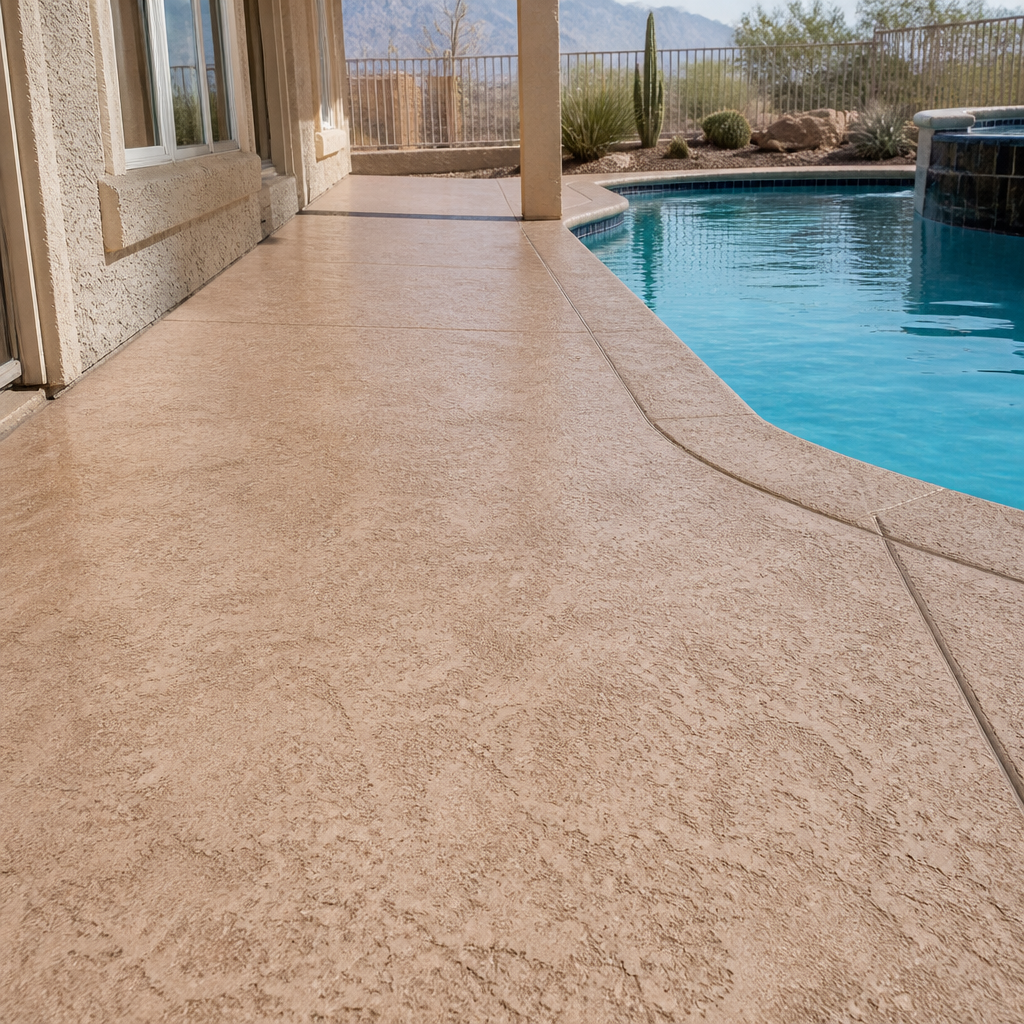
Cool deck style finishes are applied as a textured overlay that bonds to the existing concrete surface, providing a fresh appearance, improved slip resistance when wet, and the heat-reducing properties that make them a popular choice in Southern Arizona. They are available in a range of colors that complement different pool finishes and landscaping aesthetics.
Spray Texture Coatings
Spray texture coatings, also commonly called spray deck or knockdown texture finishes, are applied using spray equipment to create a textured surface that provides good slip resistance and a fresh, clean appearance. These coatings are among the most widely used pool deck resurfacing options in the Southwest because they apply quickly, bond well to existing concrete, and are available in a broad range of colors.
Spray texture finishes can be applied in single colors or in multi-tone applications that create a more naturalistic, varied appearance. They are sealed after application to provide moisture resistance and extend the life of the color and texture. In Tucson’s UV-heavy environment, using quality UV-stable pigments and sealers is important for maintaining color integrity over time.
Stamped Concrete Overlay
Stamped concrete overlays apply a new concrete layer over the existing deck and use textured stamps to create the appearance of natural materials including stone, slate, brick, or pavers. The result is a deck surface that has the visual character of premium natural materials without the cost of full demolition and replacement.
Stamped overlays are well-suited for pool owners who want a higher-end aesthetic and are prepared to invest in a finish that has more visual complexity and premium appearance than standard spray texture. In Tucson neighborhoods like Catalina Foothills and Casas Adobes where outdoor living spaces are designed with care, stamped overlays pair well with pebble pool finishes and natural stone coping to create a cohesive resort-style backyard aesthetic.
Color staining is typically applied to stamped overlays to enhance the natural material appearance, and sealers protect the finish from UV exposure and chemical contact. Like all decorative concrete, stamped overlays benefit from periodic resealing to maintain their appearance and protection.
Exposed Aggregate Resurfacing
Exposed aggregate finishes reveal the natural stone or decorative aggregate embedded in the concrete or overlay material, creating a surface with natural texture, color variation, and a classic appearance that holds up well over time. The aggregate texture provides good slip resistance and conceals surface wear better than smooth finishes, making it a practical choice for active pool decks.
Exposed aggregate in warm earth tones complements Tucson’s desert landscape beautifully and pairs well with natural stone coping and pebble pool finishes. The texture is durable and does not require the same level of maintenance as painted or coated surfaces that need periodic reapplication to maintain appearance and protection.
Concrete Overlay and Micro-Topping
Concrete overlays and micro-toppings apply a thin layer of specialty cementitious material over the existing deck, creating a fresh surface that can be finished in a range of textures and colors. These systems are well-suited for decks that have surface-level deterioration but sound underlying structure, and they can transform the appearance of a weathered deck without the cost of full replacement.
Micro-topping systems produce particularly clean, modern finishes in smooth or lightly textured applications that suit contemporary pool designs. Overlays can be applied in thicker profiles to address minor surface irregularities and provide more texture definition than micro-toppings.
Travertine and Natural Stone Pavers
For pool owners seeking a premium finish with natural beauty and excellent heat-management properties, travertine and natural stone pavers are an outstanding choice. Travertine in particular has become one of the most popular pool deck materials in Tucson and throughout the Southwest because its natural composition keeps it cooler than dense concrete in direct sun, its textured surface provides good slip resistance, and its warm, natural tones complement both the desert landscape and a wide range of pool finishes.
Paver installations involve removing or overlaying the existing deck surface and laying individual pavers in a pattern over a properly prepared base. While this approach is more involved and carries a higher material cost than coating-based resurfacing options, the resulting finish has a longevity and natural beauty that many Tucson homeowners consider worth the investment, particularly for resort-style backyard designs.
Ready to Start Your Tucson Pool Project?
Pool Deck Crack Repair: Getting It Right Before Resurfacing
Crack repair is one of the most important steps in any pool deck resurfacing project, and it is one of the areas where the quality of the prep work has the most influence on how long the finished resurfacing holds up.
Applying a new surface coating over existing cracks without properly repairing them first results in those cracks reflecting through to the new surface relatively quickly, particularly in Tucson’s thermally active environment. Thermal cycling that opens and closes the underlying crack will stress and eventually crack the surface coating above it, regardless of how well that coating is bonded to the surrounding concrete.
We assess every crack we encounter before determining the appropriate repair approach. Factors we consider include the width and depth of the crack, whether the crack shows evidence of active movement or has been stable, what the underlying cause of the crack is, and how the crack location and orientation relate to the thermal and soil movement forces acting on the deck.
Narrow, stable cracks are treated differently than wide or active cracks. Moving cracks require flexible repair materials that can accommodate continued movement rather than rigid fills that will simply fracture again. Cracks caused by settlement require addressing the settlement condition where possible, as filling a crack without stabilizing the underlying cause is a temporary measure at best in Tucson’s active soil environment.
Proper crack preparation includes routing or grinding the crack to create a clean, mechanically sound profile for the repair material, removing loose concrete from the crack edges, and applying an appropriate bonding primer where required by the repair material. The repair material is then applied and finished to provide a surface that is as close to flush with the surrounding concrete as the crack geometry allows.
Getting crack repair right before resurfacing is not a step we rush or skip. It is the foundation that determines how long the resurfacing investment holds up.
Surface Preparation: The Foundation of Lasting Resurfacing
Beyond crack repair, thorough surface preparation is the single most important factor in how well a resurfaced pool deck holds up over time. A resurfacing coating is only as good as the bond it forms with the underlying surface, and that bond depends entirely on the preparation work done before the coating goes on.
Our surface preparation process for pool deck resurfacing includes:
- Pressure washing and cleaning to remove dirt, algae, calcium deposits, old sealer residue, and any contaminants that would prevent the new coating from bonding properly to the concrete. For heavily contaminated surfaces, chemical cleaning agents appropriate to the specific type of contamination are used alongside pressure washing to ensure the surface is genuinely clean rather than just visually clean.
- Mechanical preparation through grinding, scarifying, or shot blasting to create a surface profile that provides mechanical bonding for the new coating. Smooth concrete surfaces do not provide adequate bonding for most coating systems without mechanical profiling. The correct profile depth depends on the specific coating system being applied.
- Concrete repair addressing spalled, deteriorated, or delaminated surface areas that would not provide a sound substrate for the new coating. Applying a resurfacing coating over deteriorated concrete simply transfers the deterioration problem to the new surface. Areas of unsound concrete are removed and repaired with compatible patching materials before the resurfacing coating is applied.
- Priming with appropriate bonding primers where required by the coating system and surface conditions. Primers improve adhesion, seal porous concrete, and provide a uniform substrate for the topcoat application.
Skipping or rushing surface preparation is the most common reason pool deck resurfacing fails prematurely. We invest the time and effort in preparation that every project requires, because a resurfacing job that lasts 10 years starts with preparation that was done right.
Heat Management: A Critical Consideration for Tucson Pool Decks
No discussion of pool deck resurfacing in Tucson is complete without addressing heat. A pool deck that is too hot to walk on comfortably in bare feet is not a functional pool deck during Tucson’s summer, which is precisely the time when the pool is used most.
Different resurfacing materials manage heat very differently. Dense, dark-colored concrete surfaces absorb and retain the most heat. Light-colored surfaces reflect more solar radiation and stay cooler. Textured surfaces with more air exposure dissipate heat somewhat more effectively than smooth surfaces. Materials with lower thermal mass heat up and cool down more quickly than dense concrete. And certain specialty coatings incorporate materials specifically designed to reflect infrared radiation and reduce surface temperatures.
When making resurfacing material recommendations for Tucson pool decks, heat management is one of the primary factors we weigh alongside aesthetics, durability, slip resistance, and budget. A beautiful deck finish that is unusable during peak summer hours because of heat is not a successful resurfacing outcome for a Tucson homeowner.
We help you understand how each material option performs from a heat management perspective and make recommendations that balance appearance and practicality for our specific climate.
Slip Resistance: Safety on a Wet Pool Deck
Slip resistance is a non-negotiable consideration for any pool deck surface. Wet pool decks are inherently slippery environments, and the right surface texture dramatically reduces the risk of slips and falls that are among the most common pool-related injuries.
Different resurfacing materials provide different levels of slip resistance based on their surface texture and profile. Smooth finishes provide less slip resistance than textured ones. Aggregate finishes provide good inherent texture. Spray texture coatings can be adjusted for texture level during application. Stamped overlays have relief texture that provides grip.
Beyond the inherent texture of the resurfacing material itself, the condition of the surface matters as well. A textured surface that has been sealed with a high-gloss sealer may be more slippery when wet than the same surface with a lower-sheen slip-resistant sealer. We select sealers and finishing products appropriate for pool deck applications that maintain slip resistance even when the surface is wet.
We also consider the specific areas of the deck and their relative slip risk. The immediate pool edge, steps, and transition areas see the most splash and dripping water and benefit most from maximum texture. Seating and sunbathing areas may have slightly different texture priorities while still maintaining safe levels of slip resistance.
Pool Deck Drainage and Grading
A properly resurfaced pool deck should drain water away from the pool and toward appropriate drainage points efficiently. Poor deck drainage creates standing water that is a slip hazard, accelerates surface deterioration, and can direct water toward the pool structure or house foundation in ways that cause secondary problems.
Before resurfacing, we assess the deck’s current drainage patterns and grading. If existing drainage is inadequate, we address grading corrections or drainage improvements as part of the resurfacing preparation to ensure the new surface performs correctly. Applying a beautiful new surface over a deck with drainage problems simply covers those problems temporarily rather than solving them.
Proper drainage slope away from the pool edge and toward deck drains or landscape edges is a functional requirement that we factor into every resurfacing project rather than treating as an optional consideration.
Serving Tucson Pool Deck Resurfacing Clients Across the Metro
We provide pool deck resurfacing services throughout the greater Tucson area, including:
- Catalina Foothills, where hillside custom homes and resort-style pool areas call for premium deck finishes that complement sophisticated outdoor living spaces
- Oro Valley, where established neighborhoods have a large stock of pool decks that were last resurfaced 10 to 15 years ago and are ready for a fresh update
- Marana, a rapidly growing northwest Tucson community where pool deck resurfacing demand continues to increase alongside the area’s expanding residential base
- Casas Adobes, a mature northwest Tucson neighborhood with many pool decks showing the effects of years of desert sun and monsoon cycling
- Rita Ranch, where southeast Tucson family pools see heavy deck use through Tucson’s long summer and require durable, heat-managed surface solutions
- Sahuarita and Green Valley, where seasonal residents want their pool decks refreshed and ready before the swim season begins
- Vail and Corona de Tucson, growing east-side communities with increasing demand for pool deck resurfacing as the area’s housing stock ages
- Central and Midtown Tucson, including established neighborhoods where aging pool decks benefit from professional resurfacing that restores safety and appearance
- South Tucson and surrounding communities, where residential pool decks of all ages benefit from professional resurfacing services tailored to Tucson’s demanding conditions
Our Pool Deck Resurfacing Process
Every pool deck resurfacing project we undertake follows a structured process designed to produce a result that looks great and holds up over time in Tucson’s demanding environment.
- Step 1: Deck Assessment and Consultation We begin with a thorough assessment of your deck’s current condition, including surface deterioration, crack mapping, drainage evaluation, and substrate soundness testing. We discuss your goals, your preferences for finish type and color, and how the deck finish should relate to your pool interior and surrounding landscape. This conversation shapes every decision that follows.
- Step 2: Detailed Written Proposal You receive a written proposal specifying the exact scope of work, the resurfacing system to be used, surface preparation requirements, crack repairs included, the project timeline, and the full investment. We walk through the proposal with you and address every question before you commit to anything.
- Step 3: Surface Preparation All furniture, equipment, and anything else on or near the deck is cleared. We protect pool water, tile, coping, and any surfaces that are not being resurfaced. Surface preparation begins with pressure washing and cleaning, followed by mechanical preparation appropriate to the resurfacing system being applied. Crack repairs are completed during this phase.
- Step 4: Priming and Base Coat Application Bonding primers are applied where required by the resurfacing system. Base coats, leveling layers, or scratch coats are applied as required by the specific system to build the foundation for the finish coat.
- Step 5: Finish Coat Application The finish coat is applied using the technique appropriate to the resurfacing system, whether spray application for texture coatings, hand trowel for overlays, or stamp application for decorative systems. Color, texture, and pattern are established in this phase. Multiple coats may be applied depending on the system requirements and the desired finish depth.
- Step 6: Sealing and Curing The appropriate sealer for the resurfacing system and application is applied once the finish coat has cured sufficiently. Sealers protect the finish from UV degradation, chemical exposure, and moisture infiltration, and they establish the final surface sheen and slip resistance characteristics. Adequate curing time before foot traffic and pool use is observed and communicated clearly to you.
- Step 7: Final Inspection and Walkthrough We conduct a thorough inspection of the completed deck, checking for coverage uniformity, proper texture, correct drainage, and overall finish quality before calling the project complete. We walk through the finished work with you, cover maintenance and care guidance for your specific deck finish, and make sure you are completely satisfied with the result.
Maintaining Your Resurfaced Pool Deck in Tucson
Getting the most out of a pool deck resurfacing investment in Tucson requires some basic ongoing maintenance appropriate to your specific finish type. Here is what we advise for resurfaced deck longevity in our climate:
- Regular cleaning removes the desert dust, calcium deposits, and organic material that accumulate on Tucson pool decks regularly. A periodic rinse and light scrub with a deck cleaning product appropriate to your finish type keeps the surface looking clean and prevents contaminant buildup that can stain or degrade the surface over time.
- Periodic resealing extends the life of coating-based resurfacing systems significantly. UV exposure in Tucson degrades surface sealers faster than in lower-UV environments, and resealing on the appropriate schedule for your specific finish type maintains the color protection, moisture resistance, and slip resistance properties of the sealer. We advise you on the right resealing interval for your deck system when we complete the project.
- Prompt stain treatment handles calcium deposits, rust stains from deck furniture, and organic staining before they become deeply embedded in the surface. Fresh stains are always easier to address than ones that have had time to penetrate and bond with the surface material.
- Furniture pad use under metal and heavy furniture legs prevents the scratching and point loading that can damage resurfaced surfaces over time, particularly on coating-based systems.
- Avoiding harsh chemical contact protects the deck surface from degradation caused by concentrated pool chemicals, rust removers, or other harsh products applied directly to the deck. Rinsing splash water off the deck periodically reduces the cumulative chemical exposure at the pool edge.
Pool Deck Resurfacing and Pool Renovation: Better Together
One of the most rewarding aspects of pool deck resurfacing is how dramatically it elevates the entire pool area when it is paired with other pool renovation work. A newly resurfaced pool interior, new tile, and updated coping surrounded by a fresh, well-chosen deck finish creates a cohesive backyard transformation that far exceeds what any single element achieves on its own.
Many Tucson homeowners time their pool deck resurfacing to coincide with a pool interior resurfacing or broader renovation for exactly this reason. When the pool is already drained and the work area is open, addressing the deck alongside the pool itself minimizes disruption and produces a unified result. The ability to coordinate the deck finish color and texture with the pool interior material, the coping style, and the surrounding landscape creates an integrated outdoor living space rather than a collection of mismatched elements updated at different times.
If you are considering both pool interior resurfacing and deck resurfacing, we can plan and execute both as part of a single coordinated project that minimizes the total disruption time and produces the most cohesive finished result.
Give Your Pool Deck the Attention It Deserves
Frequently Asked Questions
How long does pool deck resurfacing last in Tucson?
The lifespan of a resurfaced pool deck in Tucson depends on the material used, the quality of the preparation and application, and how well the deck is maintained afterward. Spray texture coatings with proper sealing typically last 5 to 10 years before recoating is needed. Stamped concrete overlays and exposed aggregate systems generally last longer, often 10 to 15 years or more with proper care. Travertine and natural stone paver installations, when properly installed, can last 20 years or more. Tucson’s UV intensity and thermal cycling make quality preparation and periodic resealing more important here than in less demanding climates.
Can pool deck resurfacing be done without draining the pool?
In most cases, yes. Pool deck resurfacing work is performed on the deck surface surrounding the pool and does not require draining the pool itself. We protect the pool water from contamination by resurfacing materials and rinse water during the project. If the resurfacing project is being combined with pool interior work that requires draining, we coordinate the deck and pool work so they proceed in the correct sequence.
How long does pool deck resurfacing take?
Most residential pool deck resurfacing projects take 3 to 5 days from start to final sealing, depending on the deck size, the resurfacing system used, and the extent of crack repair and preparation required. Curing time before full foot traffic and furniture placement adds additional time after the visible work is complete. We provide a specific timeline in your proposal so you can plan accordingly.
Will resurfacing fix cracks in my pool deck permanently?
Crack repair prior to resurfacing addresses the visible crack and creates a stable surface for the new coating. Whether that repair holds permanently depends on whether the underlying cause of the crack has stabilized. Cracks caused by soil settlement may continue to move if the soil conditions causing the settlement have not been resolved. We assess each crack’s underlying cause and are transparent about the expected longevity of the repair given the conditions at your specific property.
Can pool deck resurfacing make my deck safer?
Yes, in multiple ways. New resurfacing materials with appropriate texture and slip-resistant sealers significantly improve traction on wet deck surfaces compared to worn, smooth, or deteriorated existing surfaces. Crack repair removes trip hazards created by heaved or settled deck sections. Heat-managing surface materials reduce the risk of burns from an overheated deck surface. A properly resurfaced deck is meaningfully safer than a worn, deteriorated one.
What is the difference between pool deck resurfacing and pool deck replacement?
deck resurfacing applies a new surface coating or overlay over the existing concrete structure, restoring appearance and function without removing the existing slab. Pool deck replacement involves demolishing and removing the existing concrete and constructing a new deck from the ground up. Resurfacing is appropriate when the underlying concrete structure is sound and the issues are surface-level. Replacement is warranted when the underlying structure has failed, significant drainage or grading corrections require reconstruction, or the homeowner wants to change the deck layout or footprint significantly. For most Tucson pool decks that are showing surface deterioration and cracking, resurfacing delivers excellent results at a fraction of the cost of replacement.
How do I choose the right resurfacing material for my Tucson pool deck?
The right material depends on your priorities among heat resistance, slip resistance, aesthetics, durability, and budget. For Tucson homeowners who prioritize comfort underfoot during summer heat, cool deck style coatings or travertine pavers are strong choices. For those prioritizing aesthetics and a premium finish, stamped overlays or natural stone pavers deliver the most visual impact. For a practical, durable, and cost-effective refresh, spray texture coatings are a reliable choice. We help you work through these priorities during the consultation and make a recommendation that fits your specific situation rather than defaulting to a single option for every project.
Does pool deck resurfacing add value to my home in Tucson?
A fresh, well-executed pool deck resurfacing improves the overall presentation of your outdoor living space and contributes positively to how your home shows to potential buyers. In Tucson’s real estate market, where outdoor living areas are important to buyers, a pool area that looks well-maintained and updated is a genuine asset. While the direct value impact varies by property, a resurfaced deck that complements a well-maintained pool consistently presents better than a worn, cracked deck regardless of how nice the rest of the property looks.